Thursday, 21 September 2023

Schemes, Mice and Men.


In 1785, Robert Burns wrote one of his most famous poems, “To A Mouse”. It contains the lines:


The best laid schemes o’ Mice an’ Men

Gang aft agley,

An’ lea’e us nought but grief an’ pain,

For promis’d joy!


Which, for those of us who do not speak the language can be translated as:

The best laid schemes of Mice and Men

Go oft awry,

And leave us only grief and pain,

For Promised joy!


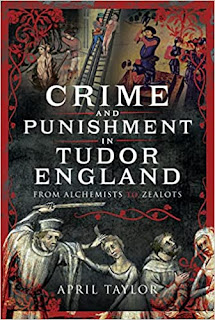
And so it proved with the publication of Crime and Punishment in Tudor England: From Alchemists to Zealots, which should have been published on 30th August. A glitch at the printers, which nobody knew about – or if they did, kept it to themselves – meant that all the preparations to promote the book suddenly screeched to a halt. I managed to stop all the blogs etc. save one from going out. And that, naturally, was my blog!

A friend, a more sanguine writer than I, said these things happen. Let’s just say it wasn’t one of my better days, since I spent most of it fulminating against everything, although readers will be happy to learn I didn’t kick the dog, only the filing cabinet.

However, as the late, much-missed Claire Rayner said This, too, will pass. And so, 21 days later than scheduled, the book is out in the world and available for purchase. Hurrah!


To precis the blog that went out by accident, and so you don’t have to look it up, this is what it said:


Crime and Punishment in Tudor England: from Alchemists to Zealots 


is is not an academic book, but for the Everyman reader or those who will find it a source for more in-depth research should they so wish.

The book reviews the law as it developed from Roman law through the Vikings and King Alfred. The latter spent time in Rome soaking up the legal system and was familiar with it. He brought some of its tenets into English law when he became king. 

Then follows a look at policing—dire, unpaid, and dangerous, prisons, equally appalling, and the effect of population movement on law & order in Tudor England. How agricultural and other rural practices affected the movement of people from the country to the towns in an effort to find work. This, of course, had an ongoing effect on vagrancy and begging. And, of course, beggars, as they are sometimes perceived in our 21st-century, were viewed with hostility, suspicion, and violence. 

I must warn readers of a delicate constitution, there is a gory section, which details the punishments and exactly what happens to the body when those punishments are inflicted upon it. If you want to know what happens when you are decapitated, burned, boiled or hanged, this section is for you. However, I do give you a warning that some might find it too upsetting to read. I will leave you to imagine what it was like to research and write, but I felt it would be cowardly to leave that section out.

The first part of the book sets the scene for specific Case Studies, where you will find the weird, the wonderful, and the far from wonderful. You will meet arch con-man Gregory Wisdom and find out that stupidity is not a 21st century attribute, nor limited to the poor; John Daniell, who tried to blackmail the puissant Robert Devereux, Earl of Essex, favourite of Queen Elizabeth I; why so many women accused of witchcraft confessed to things nobody today would believe; where Charles Dickens found his ideas for Oliver Twist; the different levels of treason, and many more.

Crime and Punishment in Tudor England: from Alchemists to Zealots is out now.

You can find it here: https://bit.ly/3PLEM93 and here: https://mybook.to/Bt34P5 


You can read more about April Taylor here:

 Twitter  Amazon UK  Amazon USA Facebook


Wednesday, 30 August 2023

How did a writer of historical crime fantasy come to write a non-fiction book on Crime and Punishment in Tudor England?

 About 15 years ago, I was on a cruise ship going around the Caribbean islands for a month. It was not a pleasure cruise; I was responsible for forming and teaching the passengers who had joined the cruise choir. Some of them hadn’t sung since they were at school, but they had to learn enough music to sing two concerts given in front of all the other passengers. It was fun. 

But as I stared out at the port of Antigua, singing was the last thing on my mind. A phrase—Henry’s black-eyed boy—kept running through my head. I wanted to write a book about what might have happened had Anne Boleyn given Henry VIII the strong, healthy, male heir he so desperately wanted. Which meant, of course, changing history. 


Well, that was a problem, because pedantic is my middle name and I didn’t want to change the history. So how could I change the history but only tweak it a bit? I couldn’t, so, in the end, I decided to not only change history but play into the beliefs and fears of magic and witchcraft so prevalent in the Middle Ages. The Tudor Enigma, featuring my apothecary at Hampton Court Palace was born, and the books were accepted and published by Harlequin.


Fast forward 8 years, and suddenly, an email from Pen and Sword Publishing popped into my inbox. The editor loved The Tudor Enigma books and how did I feel about writing a proper non-fiction book on crime and punishment in Tudor England?


How did I feel? Panicked, yes; enormously complimented, yes; terrified, yes. I said yes. Two years later, Crime and Punishment in Tudor England: From Alchemists to Zealots has just hit the bookshops. I won’t lie, it was sometimes a soul-searing experience. The depth of man’s inhumanity to man, not just in how the punishments were allocated, but how some were refined to extend the victims’ agony, led me to some very dark places.  


Crime and Punishment in Tudor England: from Alchemy to Zealots, is not written for an academic audience, but for the Everyman reader. In other words, for those people who know a bit, or even, perhaps, very little about ordinary life in Tudor England and would like to know more; but in an accessible way and with some low-key humour thrown in.


The book begins with a review of how things were before that momentous day on 22nd August 1485 when Richard III was killed on Bosworth battlefield. Richard had worn his crown into battle but lost it while he was being hacked to death. It was found in a nearby bush, and Henry Tudor’s supporters lost no time in placing it on his head. 


The book reviews the law as it developed from Roman law through the Vikings and King Alfred. The latter spent time in Rome soaking up the legal system and was familiar with it. He brought some of its tenets into English law when he became king. And, of course, it is to Roman law that we owe many of our current legal Latin terms.


The book then reviews the state of policing—dire, unpaid, and dangerous, prisons, equally appalling, and the effect of population movement on law & order in Tudor England. How agricultural and other rural practices affected the movement of people from the country to the towns in an effort to find work. This, of course, had an ongoing effect on vagrancy and begging. And, of course, beggars, as they are sometimes perceived in the 21st-century, were viewed with hostility, suspicion, and violence. 


I have to warn you there is a gory section, which details the punishments and exactly what happens to the body when those punishments are inflicted upon it. If you want to know what happens when you are decapitated, burned, boiled or hanged, this section is for you.  


The foregoing sets the scene for Case Studies, where you will find the weird and the wonderful, and the far from wonderful. You will meet arch con-man Gregory Wisdom and find out that stupidity is not a 21st century attribute, nor limited to the poor; John Daniell, who tried to blackmail the puissant Robert Devereux, Earl of Essex, favourite of Queen Elizabeth I; why many women accused of witchcraft confessed to things nobody today would believe; where Charles Dickens found his ideas for Oliver Twist; the different levels of treason, and many more.


"Crime and Punishment in Tudor England: From Alchemists to Zealots". 

Here is the link:
 
https://t.co/LuiSW5trex


Wednesday, 23 August 2023

Workers’ playtime ain’t what it used to be: The work/life balance

Reams have been written about the work-life balance. How vital it is for our wellbeing and mental health to make sure that life is not all about work. That we remain human beings and not human doings.


So one wonders why some countries – and although I am highlighting the USA here, I know other countries are just the same - still have a mindset that if workers take the holiday they are due, they are somehow slackers, not committed to their job; that if they are not on call 24/7, they are not pulling their weight; that they must never go anywhere without their phone in their hand. They are conditioned to be driven, otherwise they are sub-standard. In the USA, some people have been fired for taking time off because they are ill. If you’re not here, I will find someone who can be. The people who inhabit the land of the free have so little holiday time they have to fit a lifetime of experiences into two weeks or fewer.  That’s relaxing…not.  This is a lifestyle being promulgated by industry slowly but surely.


 That leads on to what these driven people do in the few hours they are not at their desk. Do they sit back, kick off the shoes and look at the ocean? Seemingly not. Millions of them have a work hard, play hard mindset; they conquer the world at their desk and then go and kill somebody on the squash court. I cannot help but think this will end up with their brains like engines on maximum revs 24/7, leading to breakdowns and burnouts.


 It is well documented and has been for years that people need downtime from work in order to make their work life mindset function at a higher level. All work and no play doesn’t just make Jack a dull boy, it makes him a sick boy. Here are a few studies you might find interesting:


https://link.springer.com/article/10.1007/s10902-012-9345-3

https://www.ncbi.nlm.nih.gov/pmc/articles/PMC6617405/

https://hbr.org/2004/10/presenteeism-at-work-but-out-of-it 


Writers are no different. We, too, need a work/life balance, but even those of us who are lucky enough not to need a day job and who work from home, don’t always find it easy to live a balanced life. Because if we are not writing, we are usually working out plot twists or what happens next, or what aspect of research we are going to tackle tomorrow. 


I have, in the past, managed to work out the details of a complicated plot twist whilst cross-stitching an entire row of stitches in the wrong colour. More than once. If I am walking the dog, I am likely to be dictating the next bit of the story or muttering bits of dialogue to myself. Or, when accompanied by my (human) dog-walking companion, explaining abstruse bits of history to her, or talking through why my main character has to do what he/she is about to do. Why on earth she would be interested in me pondering the reason William of Ypres retreated at the Battle of Lincoln in 1141, with his contingent of troops, in the least bit interesting is debatable. (Especially when contemporary chroniclers accused him of cowardice in leaving King Stephen to be captured by the Empress Matilda’s forces. My opinion is that he obeyed the instructions of Sun Tsu in The Art of War, and there is every reason to think that William, educated as he was, and experienced, hardened battle commander as he was, had read Sun Tsu’s advice.) See, I’m at it again! 


What I am trying to say is that, we writers need to leave the words behind for a few hours every day and concentrate on something completely different that requires total concentration, in order to be fresh enough to come back to the words the next day with renewed enthusiasm. By which I mean something complicated but different. For me that is dressmaking, painting, and singing. You can’t sing properly if half your brain is thinking about your latest magnum opus, and you certainly can’t sew properly if you aren’t concentrating on putting on that facing so it fits perfectly. If you don’t, you are likely to sew it on the wrong side of the garment; (been there, done that).


I am learning – slowly – that my relaxation is just as important as my work time. That if I am not at my desk all the time, that is good. And that if I don’t take the downtime, the writing I do produce will be not my best work.


  Dangers of Destiny: Book 1 in the Luke Ballard Chronicles


https://mybook.to/aEYs


Crime and Punishment in Tudor England: From Alchemists to Zealots


Published by Pen and Sword on 30th August 2023


https://mybook.to/eDdY9


You can find out more about me here:


Twitter  Amazon UK  Amazon USA 


Friday, 9 June 2023

Can you make a fantasy world believable?


I am pedantic and I do not mind admitting it. Pedantic with a deep love of British history from the Normans to the Tudors. So, when I wanted to create the Luke Ballard Chronicles in my fantasy Tudor world, a world where Anne Boleyn was Henry VIII’s second and last wife and still his Sweet Nan, I knew it would only work for me if I kept the history as authentic as possible.


It was only about five years ago I realised my original inspiration was the Lord Darcy books by Randall Garrett, which I read almost half a century ago. I loved the world he built, where the Plantagenets were still monarchs aided by magicians, who used traditional paraphernalia of sorcery. As I write this, have decided I will now find the books and re-read them.

 However, back to the plot! My decision was that everything that had happened in the Tudor era up to 1536 should remain true, but the world I built after that, would still have people we know about, like Jane Seymour and Thomas Cromwell. Their roles in my books would be a little different. In order to write this kind of book and make it believable, the writer must have a sound knowledge of the period in which the books are set. And, since Pen & Sword Publishing commissioned me to write Crime and Punishment in Tudor England: from Alchemists to Zealots, I like to think I have achieved that.

 My principal problem was making my apothecary from the Outer Green of Hampton Court Palace a magician. Especially in an era when the slightest whiff of anything that smacked of sorcery was a quick road to being burned alive—in other words, without the executioner strangling the victim first.

Balance and the order of the universe were principal beliefs at that time. When Shakespeare makes Northumberland, upon hearing that his son, Hotspur has been killed in battle say:

Let heaven kiss earth! Now let not Natures hand

Keep the wild flood confined. Let order die…

that is Shakespeare’s shorthand conveying the father’s utter desolation at the death of his son. And everyone in the audience would have recognised it as such.

To be believable, my world had to have strict boundaries. I decided my apothecary would have limited powers; he would be an elemancer, casting his spells by calling on the power of the elements, but only ever working in the light and love of God. But my elemancer would need assistance. I invented helpmeet dogs, greysprings, springing spaniels (their medieval name) crossed with greyhounds, to produce a dog with the scent skills of the spaniel, but the sight abilities of the greyhound. And, to maintain the order and balance of the universe, elemancers would have mortal enemies, sunderers, whose only ambition was to cause chaos and strife, and thus gain power and riches. In a parody of their foe, sunderers also had nasty, ugly, vicious dogs called umbrans who helped them.

When I first had the idea, my intention was to begin after Henry VIII’s death, with his son by Anne Boleyn now Henry IX. And that was the first book I wrote. Harlequin liked it, sent me a contract, and I wrote two more. For various reasons, I decided that would be it for Luke Ballard. And, under the terms of the contract, I could not write about him for 7 years. So, I turned elsewhere and wrote other things. But Luke remained, stubbornly fixed, in the back of my head. I wanted to tell the story of how he came to be an elemancer, and how he came to work for the monarch. Thus was Dangers of Destiny born.
The books originally published by Harlequin will be rewritten and re-issued as sequels. And there are plots for further three after those. 

In all the books, I have referred to events that actually happened, but changing just a few details so that they set the storylines firmly in their time, detailing real events. What I really wanted was for my readers to wonder if, in some parallel universe, these things could actually have happened. 


You can find Dangers of Destiny here:  https://mybook.to/aEYs


Crime and Punishment in Tudor England: from Alchemists to Zealots will be published by Pen and Sword on 30th August 2023. You can pre-order it here: https://bit.ly/43f0jeB   


You can read more about April Taylor here:

 Twitter  Amazon UK  Amazon USA YouTube


Thursday, 1 June 2023

Introducing Luke Ballard. Apothecary at Henry VIII’s Hampton Court Palace. Oh, and he is a magician, too…

 When I first conceived the basis of the Luke Ballard stories, I was in the middle of the Atlantic, on a cruise ship, responsible for turning passengers, many of whom hadn’t sung since they were at school, into a choir and teaching them to sing as a united entity. And giving two concerts to the rest of the passengers to prove I had. And not making a fool of myself.

Instead of worrying about the tenor line in Elgar’s As Torrents in Summer, I was listening to a voice in my head telling me to write about Henry’s black-eyed boy. When I finally had time to sit and think it all out, and play what-if?, Henry’s black-eyed boy turned out to be Henry VIII’s son by Anne Boleyn.

In real life, Anne miscarried him. In my thesis, I decided he had lived, that Anne had overthrown all conspiracies aimed at ousting her, and she was still Henry VIII’s Sweet Nan. All of which meant I had to change history to what might have happened in a parallel universe. And, since the universe was mine to build, I would add in magic. 

It took a while to find Luke Ballard, my protagonist. He would be an elemancer - a magician who casts his magic in the light and love of God and always works for justice. His magic was to be based around elements and, in the interests of maintaining the balance of the universe, he had to have enemies. Sunderers, in fact, whose only ambition is to gain power and wealth, preferably by demonic means. 

I wrote 3 books, originally published by Harlequin, but I wanted to tell the story of what happened before Henry VIII died; how Luke came into his own. Which led directly to Dangers of Destiny. This is the new prequel to the series formerly known as The Tudor Enigma, but which will now be called The Luke Ballard Chronicles.

In Dangers of Destiny, Luke Ballard is a raw apprentice elemancer, sent into Hampton Court Palace to identify the sunderer who has put King Henry VIII into a deep trance. If Henry dies, England will descend into chaos, allowing the Catholic European powers to gain control. Time is short. The King grows weaker by the day. But in the midst of the many intrigues and conspiracies whirling around the palace, how can Luke tell friend from foe? Who can he trust? 

Can Luke, thrown into the maelstrom of the Tudor court, identify and destroy the enemy while remaining undetected, and save the King’s life? The stakes are high. And highest for Luke if he fails.


The original three books will be revised and re-issued in due course.  

Dangers of Destiny is free on Kindle Unllimited or £3.99 from Amazon.

You can find it here: https://mybook.to/aEYs

You can read more about April Taylor here:

 Twitter  Amazon UK  Amazon USA YouTube


Wednesday, 21 December 2022

Why are some authors like harp seals?


Hurrah! Who Wants To Live Forever is out in the world. Yay! This will be—allegedly—Georgia Pattison's last case. 

And, as is always the case, the most enjoyable part of writing any book is…the writing. So, where do harp seals come into this, I hear you ask. Because it is the bit after the birth of the book that is a complete pain in the neck. Let me explain.

Did you know snakes have no maternal instincts? At all. They lay eggs and don’t bother to hang about to see if they hatch or if the snakelets manage to fight off predators. Female harp seals are little better. They are glued to their pups for about 2 weeks, during which, mum doesn’t eat anything. After that, she abandons her offspring—presumably to nip up to the local fish shop. 

Some authors, of whom I am one, are a bit like that. 

We get the “great idea”, play “What-if?” for a while to see if it has legs, and jot down a few notes or create a detailed plot line. We “see” our characters, imagine them in different scenarios. Then, we sit and write that first draft, which for this author, is a white-hot, full-pelt, romp through about 90,000 words, not bothering to agonise as to whether any particular word is the right one, simply getting the story on the page. Finishing that first draft is a mixed blessing. The story is there, in black and white, but it is never the spectacular, perfect entity that I imagined. And how could it be? But it has been fu

In the case of Who Wants To Live Forever, the what-if? spark was What if someone was murdered at a wedding and then it transpired the victim was..... And off I went.

Then begins the sojourn in the Editing Cave. Some authors love editing. I have grown to quite like it. This is the time when I can agonise over making sure I have the right word in the right place. First of all, does the structure of the book hold together? Are there any plot holes, anywhere where your reader is going to say How did she know that? Have the clues been seeded carefully enough? One of my readers paid me the enormous compliment of saying I went back and the clue was there and I still didn’t see it.

And, as with snakes and harp seals, it is time for the fledgling to leave the nest—or be kicked out of it. I always do promo for a couple of weeks, but then, just like the snakelets and harp seal cubs, it has to fend for itself. My books don’t so much get launched, as slide in through the back door. Why? Because the joy is in the writing, not in the promotion. And, allied to that, I cannot force anyone to buy my books and neither would I want to. But mostly, because I am usually in the process of trying to produce the next book, which will be perfect.

So for the next two weeks Who Wants To Live Forever will be looked after, shown to the world, and nurtured in the hope that a few people buy it, yes, but that they also enjoy it. And after that, it will fend for itself, except when I get a spare few minutes to think about tweeting it or Facebooking it. 


If you would like to read Who Wants to Live Forever, you can find it here: https://mybook.to/RRGsWE


But until January, I shall give the keyboard—and myself— a rest. 


A Very Merry Christmas and a Happy and Prosperous 2023 to you all!


And if you want to know more about me:

You can find me on FacebookTwitter Amazon UK 


Monday, 14 November 2022

Wading through treacle - the adventures of a writer.

  Confucius, the Chinese philosopher is alleged to have said "May you live in interesting times". I think he meant it as a curse. John Lennon was equally eloquent when he said, "Life is what happens to you when you're busy making other plans."

I think this is accurate for most of us at some point(s) in our lives. Certainly, here in the UK, everything seems to be in a state of flux. Our monarch of 70 years died suddenly - well suddenly to us - and we have had 2 prime ministers in the course of 6 weeks. It is unsettling. When that spills over into your working and private life, it can prove very difficult. A series of family illnesses, including a couple of "end of life" situations certainly puts a strain on every aspect of your daily routine. But the best thing to do is to stick to that routine if you possibly can. To keep all the balls in the air or, for those of us who remember the variety hall act, to keep all the plates spinning on top of the sticks.

My writing plan, after finishing the Tudor Crime and Punishment book for Pen and Sword and the edits, was to concentrate on picking up a book I began in 2013 as a prequel to the Tudor Enigma series published by Harlequin, and which features Luke Ballard, the apothecary in the Outer Green of Hampton Court Palace. The setting is an alternate Tudor universe that, had Anne Boleyn carried her boy baby to full term in 1534, could well have been true.

However, things didn't work out that way, either for poor Anne or for me. Harlequin decided to keep the series to three books, so the fledgling The Danger of Destiny became an unfinished manuscript. However, having had my rights to those books returned, I decided to finish the prequel. Everything started well. I managed to write the final two chapters. And then came the formidable task of filling in the gap.

All writers are aware of a pitfall called the soggy middle. That is what confronts me now. And for me to get through it, I must employ a couple of disciplines. Focus. Concentration. For writers, that manifests as sitting down at the keyboard and doing the job. It has a name. Bum Glue. The fact that I am sitting here, surrounded by notes of what has to happen in the gap between 55k words and 90k words and I am writing this blog instead, is indicative of my current butterfly brain. However, the instant I have written this, I promise I shall crack on.

So, the prequel to the Luke Ballard books. Haven't quite decided on a new title for the series yet. Luke Ballard is an elemancer - a magician governed by strict rules. Elemancers work for the good of all in the grace of God. They have - well, this is me - a helpmeet, a dog called a greyspring. In the interests of the balance of nature, if the elemancer is male, his greyspring will be female and vice-verse. 

Luke's greyspring is called Joss. She is there to protect him when he goes into trances and help when he encounters the mortal enemies of elemancers - sunderers, whose only aim is to sow discord and hatred. They also have helpmeets - little black dogs called umbrans.

The year is 1546 and Henry VIII lies ill at Hampton Court, stricken by a mystery illness. Luke Ballard, who has only recently discovered his elemancer talent, is taxed with investigating what ails the King. Young girls have been found murdered with evil signs cut into their bodies. Then another girl goes missing and one of the kitchen scullions is found drowned in the palace soup vat. It quickly becomes clear sunderers are doing their utmost to destabilise England, but just who are they and who is their master? More importantly, can Luke hide his talent enough to ensure the sunderers are unaware of him?

With luck and a following wind, I should have this first draft finished before Christmas. Wish me luck.

Wednesday, 29 December 2021

Birth of a book


Where do authors get their ideas from? I can tell you about the initial concept for Loyalty in Conflict. And, to continue the birth analogy, this book has been a long time in the writing and went through several incarnations.

I am a Lincolnshire girl, born and bred and the events behind the 1470 Battle of Empingham, also known as Losecote Field, began quite close to where my paternal family have lived since before 1794.

The idea for the book took off when I discovered Sir Robert Welles, the leader of the Lincolnshire rebels, had a manor house about 2 miles from where I lived. I tramped the countryside, found where the long-gone manor had been but where the gates can still be glimpsed through the trees from the A16.

I could see my protagonist. Gideon Rooke, a stable boy, secretly intelligent beyond his station in life and with an affinity for horses. I was also fascinated by the Lancastrian/Yorkist dynamic in Lincolnshire. The county was, like many northern counties, staunchly Lancastrian, apart from Sir Thomas Burgh, builder and owner of Gainsborough Old Hall and Master of Horse to the Yorkist Edward IV. 

(If you have the chance, take a trip to Gainsborough Old Hall - see right - it is well worth a visit.


The inciting event for the story: Lord Richard Welles and his son, Sir Robert along with a band of cohorts attacked Gainsborough Old Hall, tried to burn it down and carried away as much of Burgh’s possessions as they could. Burgh complained to the king. Edward summoned the elder Welles to London to explain his actions.

The book opens with John Rooke, Gideon’s father, warning him that they are in danger because John has overheard Sir Robert planning rebellion. He makes his son promise that, should anything happen to him, Gideon must slip away, get to King Edward and tell him of the uprising.

But while Gideon promises his father he will do so, he thinks John is worrying about nothing. Until he almost trips over his father’s corpse. That begins the conflict Gideon feels, not only about his own vow to avenge his father, but also that, by fulfilling the promise he made to John, he is in conflict with his own loyalty between the houses of Lancaster and York.


Gideon’s story has been described by one reader as a breathless adventure with Gideon like a mediaeval Jason Bourne. That is the sort of comment guaranteed to make an author very happy.

You can find Loyalty in Conflict here:  https://bookgoodies.com/a/B09NJMG74S


You can find me on Facebook, Twitter Amazon UK 


Friday, 3 December 2021

So you want to write a crime novel: Part 12: The Writing Life


This blog is about trying to avoid unnecessary heartache, as well as mental and physical stress when you try to achieve your writing dream.

The buzz word is Time Management but you don't manage time, you manage yourself.

I started writing when I was still working full-time. In order to find time to follow my passion, my life needed consistent discipline, focus and planning to live a balanced life. If you have a full-time job and run a house and have children, you need to manage your time so that not only do you find time to write, you also carve out what is now called “me” time. You must manage to achieve this in order to avoid unnecessary stress and anxiety or having to give up your dreams and goals.

Writing:

First and foremost, you must get your family and friends onside. Your writing time may be limited. You do not need to be interrupted to be asked where your partner’s shirt is! Make it a rule that your writing time can only be interrupted if the house is on fire or someone is ill. If they don't think it important, compare it to something in their lives that they think is important. Be strong, be persistent. This is your dream we are talking about.

Keep setting writing goals. Make them time-defined to keep you on track but never allow a deadline to loom so large it paralyses you. Unless you are writing to a publisher’s deadline, of course, in which case, at the first hint of a problem with the deadline, contact your editor, explain, and sort the situation.

Keep reading in your genre. This is especially true of contemporary crime because the laws of investigation, evidence etc., change very quickly. However, the more you read the more you will discover new ideas, new ways of expressing yourself on the page and new ways to write that killer twist at the end.

Never be rigid about your writing mindset. This also applies to the way you organise your stories, for example, how you plot or outline. Always be open to new ideas about how to perfect your craft. These days, the emphasis is on making everything computerised or on an app. If pen and paper works for you, don’t feel bad about sticking to it but do try these new packages out. They might just work for you. Most of them have a 7-day trial period. Use it.

When you encounter problems, decide if it is a problem or an inconvenience. A problem needs a solution. An inconvenience is simply annoying. And also remember that sometimes, however much you want to write X, you may need to throw in the towel. By delaying the inevitable, you are wasting time and energy when you could be working on something new that will work.

 Your (other) life:

Decide whether you are a lark or an owl. I’m a lark, often up at 04.30, with the dog walked by 06.00. Coffee. Then to my desk. Work until breakfast and after breakfast until morning coffee. I use a ‘productive’ diary in which I write what I will be working on the following day. So I sit down at my desk at 06.15, knowing what I will be doing and, of course, knowing this, my subconscious has also been thinking about it overnight, so the ideas flow—mostly! My time is mine by 11.00 at which time I find my life balance by indulging a hobby, going out or just chilling. Just as well because after lunch, I am brain-fogged and I cannot use my age as an excuse for this: it’s just the way it’s always been for me.

If you are an owl, you need to adjust your day the other way around. I had to do this when I was at university in the 1970s. My husband met me from the train station at 17.30, we made dinner, after which I sat down for 30 minutes and chilled. Then it was upstairs to study until 10pm followed by a quick walk to the pub and a drink. 

If you have children and a job, planning becomes an essential. Try and do several loads of washing during the week - keep it under control. Get out the clothes you are wearing the next day just before you go to bed so you don't discover the shirt you were going to wear has a stain down the front 5 minutes before you are supposed to walk out of the door. 

Teach the children to make their beds when they get out of them—their future spouses will thank you. Wash up as you cook the meal so only the plates and cutlery are left. Set times for bed, especially for the children, and stick to them because, of all the important people in the house, you are the most important. If you fall apart, everything falls apart. If you can’t follow your passion, it will impact on your mental health. That is why you must organise, plan and be disciplined. It may be a pain but it pays. If your passion is to write, do not let having to plan, organise, and be disciplined get in the way of achieving your dream. 


Be organised. I can’t say this enough. Plan the week’s meals ahead and buy in the food you need to make them. I had a very organised friend who planned a month’s meals, went out and bought the whole caboodle on Friday evening and then spent all Saturday cooking, labelling and freezing. Of course, she had to buy veggies/milk in between times but each morning she took the meal for that day out of the freezer. Job done. I’ve done this. It’s a pain. It needs initial input time to work out a month’s meals, but after that, you just recycle from Day 1. It takes discipline, but it works and it gives you back so much time.

 Time you could spend writing.


Friday, 5 November 2021

So you want to write a crime novel: Part 11: Pulling it all together


From the first minute you get that initial what if? moment, you spend the next few days playing about in your head with ideas. Why is this such fun? Because everything is new and nothing is off the table.

 In St Paul’s first letter to the Corinthians, he tells us about faith, hope and love and adds that the greatest of these is love. Borrowing from Paul’s example when you are writing any novel, there are three things that are key. Plot, setting and characters. But the greatest of these is characters. Most new crime writers do not realise this. They believe plot is everything but without characters in conflict, you do not have a book.

 The plot—see my May 2021 blog here —is simply the events that happen in your story. The setting can be wherever you want it to be, especially if you are writing a genre novel like a crime novel. You can set it in mediaeval times, Tudor times, the 1950s or on a space station. The elements of your story remain the same. Of course, the setting will affect everything to do with your characters. So if you are setting it on a space station in 2025, your characters will not behave in the same way as a group of ordinary people in, say, 1381.

 This is when your research begins—see my March 2021 blog here. If your research is not thorough and accurate, you will lose your reader. I know of one quite popular author who regularly gets facts wrong—-facts that are easily checked by a fast Internet search. For me, this is unforgivable and it shows contempt for the reader. Don’t do it.

 If you are researching something historical, make sure that everything—dress, speech, events, social mores etc—is accurate to that period. As an extreme example, it would be very stupid for anybody to suggest that William the Conqueror’s troops used guns at the Battle of Hastings. Getting research wrong is lazy and sloppy.

 Once you know your characters—see my July 2021 blog here—and you know that your research is accurate, start working on the conflict, suspense, and tension between the characters and in the events of your story—see my August 2021 blog here. Do bear in mind that in a crime novel the protagonist and antagonist have a mirror-image of the same need. The protagonist needs to solve the crime and find the perpetrator. The antagonist needs to make sure the crime isn’t solved and he/she stays free, even if that means a couple more murders.

 When I get to this stage, I have several methods of working my ideas through to the stage where they either will or will not work. One is a timeline for the protagonist and, more importantly for the antagonist. Of course, in a crime novel you also need clues so that you can seed, together with red herrings, throughout the text. Your entire focus where clues are concerned is not simply to enable the protagonist and the reader to solve the mystery, but also to confuse the protagonist and the reader with those delightful little side alleys that lead to dead ends. This is where you can make the antagonist have such fun.

 If you can make your protagonist and the reader not know which way is up, you have the basis of an excellent crime novel. However, always remember that without believable characters who are in conflict with each other and sometimes with themselves, the book will not come across as a satisfactory whole. We all know that you can make cakes using no eggs or no flour and they taste okay, but the most satisfactory cakes contain both eggs and flour.

 My next task is always to plan the events in the order in which they happen—see my April 2021 blog herewhere I talk about the different ways to outline your book and how to decide how much or how little outlining is best for the way you work. I have used index cards that can be moved about to change the order, a white board to connect A with B etc. I have also used the Scrivener software. Find what works for you.

Now comes the not-so-easy bit. Writing the first draft. For me, this has to be a white-hot romp with no second thoughts (they are for the editing process), following the outline I’ve written but with plenty of space for me to veer off the main path if I get a oooh, if X does that, it will make Y think this moment. Keep your dialogue realistic but sharp—see my October 2021 blog here. Keep raising the stakes for all the characters. Above all, enjoy watching your story grow under your fingers/as you dictate etc.

 While we are on this subject, it has been scientifically proven that we use different sides of our brains for creative stuff and evaluation stuff. I know many authors who absolutely cannot write a sentence without going back over it and polishing there and then. That, for me, is absolute death to my creativity. I am quite happy to write a chapter and edit it first thing next morning before writing the next one, but to edit while writing is not working in an effective partnership with how your brain works. It slows down that first draft from a canter to crawling through mud. The book may well, in consequence, lose momentum.

 
Over to you. Have fun. Next month, in the final blog in this series, I will write about how to fit your writing in with your life. It’s all about balance and discipline and planning. See you there.

Friday, 1 October 2021

So you want to write a crime novel: Part 10 - Dialogue


Dialogue is one of the trickiest aspects of writing a novel. The plain truth is that the dialogue we read in books is nothing like the dialogue we use when we actually speak and interact with other people. When we are face to face with someone, we use their facial expressions to interpret what they are saying. That feeds how we then respond. 

That cannot happen in a book unless you actively make one character—your POV character use others’ facial expressions as part of your deductive plan.

 If for example you have a group of characters who are all familiar with each other, their habits, and anything that the group uses will be familiar to all. Let’s say we have a group of security consultants in a thriller—if one character then says, for example, “We can ask our IT guy, Michael.”, this becomes unbelievably clunky dialogue. The group knows their IT guy is called Michael. The person saying the sentence knows the IT guy is called Michael as does the person listening to the sentence. “Give it to Mike, he’ll sort it,” would be far more realistic while still conveying information.

 The secret to successful dialogue is making it sound effortless and realistic. Widespread reading in your particular genre will soon aid you in identifying who writes excellent dialogue and who does not. Knowing the difference is key. One thing I would highly recommend is that you go to YouTube and watch small scenes from films to get an idea of how written dialogue can sound real. Look up Oscar winners for screenplays and go find their work.

As a writer, you should always be aware of people around you in public situations. Listen to their speech patterns. Listen to what I call the music of their sentences. You will find that someone who speaks in a Yorkshire accent will not speak the same song as someone from Norfolk, for example. Eavesdropping is an essential part of learning how to write effective dialogue.

 Dialogue is not just communication between characters. It gives information to the reader. If you are writing a crime novel written in the first person, one of your biggest problems is that whatever that person witnesses is all that person knows. So if for example Georgia Pattison, needs to know that X has happened, she needs somebody else to tell her it has happened because she was not there to witness it herself. Phone conversations and eavesdropping are useful for this. If the book is written in the third person, this issue becomes less of a problem.

 One of the most common problems writers encounter in writing effective dialogue is that because they are creating the speeches from within their own brain, it is very easy to fall into the trap of all the characters’ dialogue sounding the same. The same speech patterns, the same rhythm. But, not only will the words each character uses be different, their phrasing will be different: the emphasis will be different. 

The successful writer must pick this up and encompass it. One way to do this and I think it is especially important in the crime novel, is to know your characters inside out - and this includes their speech patterns and the vocabulary they use. For example, your villain, Hugo, because of his background/upbringing/goals, will have different patterns and vocabulary from Inspector Daniels with his upbringing etc.

What does Hugo’s voice sound like? Is it a snide voice? How does his view of the world and his place in it affect his speech patterns?

Your dialogue should reveal something about the character who is speaking. If it is a stand-off between your protagonist and your antagonist, they may have different but related goals. Hugo will want to avoid arrest. Daniels will work towards solving the crime and arresting Hugo. That will affect how they interact with each other.

 As an exercise, let us pretend that Hugo has slipped away from his office, come home, murdered his wife, and slipped back to his office. Inspector Daniels is the Senior Investigating Officer. Hugo, being the husband, is his prime suspect. Now, you must decide how clever or how sloppy Hugo has been in the execution of this crime. That will affect how Inspector Daniels interviews Hugo and how Hugo's ego believes he can pull the wool over the inspector’s eyes.

Now write the scene. It doesn't have to be long. Remember to make your dialogue individual to each man so that the reader does not need to read many “he said/she said”. The aim of this exercise is for you to make it clear to the reader who is speaking.

If the dialogue is a long one, you can have one character say the other character’s name. For example Daniels could say: 

' Hugo, we checked with your office. Your car was not in its parking space for 45 minutes at the time your wife was murdered.'

'Oh, for heaven's sake, this is stupid. I've just lost my wife and you're wittering on about where I parked my car. I don't suppose you have a specific time of death yet. You see, I do know about how tricky TOD is for pathologists. I'm not the moron you seem to think I am.'

'We have witnesses who are adamant your car was not in its space. Why?'

'If you must know, inspector, I parked at the other end of the car park this morning under a tree out of the sun. If you had a Merc., you'd do the same.'

'Then where were you? Your secretary couldn't find you.'

Daniels is keeping his sentences short and succinct while baiting them to make Hugo lose his cool. Hugo's sentences are longer with what he thinks are appropriately condescending comments, trying to undermine Daniels, make him believe Hugo is superior, and must be treated with more respect. It isn't working. Or, if it does work, you have to find a way to make Daniels realise he has been manipulated and formulate a plan for the next time he interviews Hugo.

Over to you. You aren't trying to write a crime novel here, just a short scene, so there is absolutely no pressure, but a lot of fun to be had.


Friday, 3 September 2021

So you want to write a crime novel: Part 9. Focus


The word focus has many meanings. Concentration is the definition that most people think of first. However as a writer focus can mean many things. It can encompass discipline, habits, and anything else that will aid you to become a more aware and mindful writer.

All writers need to exercise focus but for the crime writer the focus must be maintained to ensure that you have placed your clues correctly, you are being completely fair to the reader, your characters have revealed or hidden something from the reader, and you have worked out the balance of your scenes. Every scene must drive towards the conclusion, which is the revelation of the killer.

 So my first advice regarding focus would be for you to write notes about the scene you intend to write. Jot down the first sentence of your scene, leave a few lines and write the last sentence of your scene. By doing this you know your start and end points and clarified what you are trying to achieve. On the lines in between those two things, write the key points that you must cover. These will include actions by your characters, a seeded clue or a little revelation that might be a red herring taking your reader up the garden path or a huge clue that is so obvious the reader will be immediately suspicious that it might be a red herring. Then when you begin to write, you know where you are going, but I would always advocate leaving a bit of leeway so that if your brain suddenly thinks wait a minute, if I make Roger do X, that will confuse everybody. By making notes, you will immediately aid your focus for the scene.

 What can affect your focus? Knowing what you are going to concentrate on in your writing session, dealing with your surroundings, whether that be noise or interruptions or making sure that there is nothing in your immediate environment that is going to distract you. This includes family! Do not be apologetic about your writing. This is important to you and nobody, be it your mother who thinks it is a little hobby she can interrupt for a chat about nothing, or email, phone calls should be permitted to distract you and take your time away. 

  Focus is a time-limited activity. Some writers use “timed sprints”. These can be 30 minutes of timed concentration where you just write, followed by physical activity, be that walking around the house for 10 minutes jogging up and down the stairs or, as in my case, putting on a short 10-minute playlist and dancing. The physical act of moving about re-energises the neurons in your brain and makes you more effective when you sit down for your next timed sprint.

 Where you write. When you research the habits of successful authors, you will find that this is not a one size fits all situation. The crime writer, Ian Rankin, for example, can only write in his office at home in Edinburgh or his farmhouse in France. Nora Roberts used to say her office was a notebook and wherever she and the notebook went, that was where she wrote because she could still maintain supervision of her children but jot down her story at the same time. Some lucky writers, of whom I am one, have a dedicated room in their house that is an office. Others write on the bus going to work or have to squeeze in a couple of hours when they come home from work. 

Some writers go outside the home.  JK Rowling wrote her first Harry Potter book in the coffee shop. I have used and libraries. A new place to write occasionally kickstarts your brain into a new form of creativity. If you do decide to occasionally or even all the time, write in public spaces, you need to have a portable office that you can take with you. In other words plenty of pens, your laptop, (make sure it is fully charged!), notepads, earplugs and music, your notes and anything else that you think you will need.

 I use an A5 “activity” diary. This gives me a Monday to Friday A5 page-a-day book in which to write down my objectives for each day and how much time I will devote to each activity. At the end of each week I can review the past week, write down what went well, write down what didn't and   what will make me happy to achieve in the next seven days.

Reviewing your week in this way gives you the impetus to carry on. It is also invaluable in assessing where you are in a project and if you need to change some of your forward planning. In short, especially if you are also holding down a job, and/or have a family as well, you need something that is going to keep yourself on track.

 Being a slave to your habits will stultify your brain, so change them about from time to time. Get those brain neurons firing in a different pattern. Old habits are hard to break. They fight for their existence and they are very persuasive, because if you are leading a very busy life, it is so easy to give in to the habit. But just because you can do something does not always mean you should.

 Focus, discipline, habit, call it what you like. But the plain fact is that without it not only will you never write a book but you certainly will not be able to write a crime novel. I hope some of the ideas I have given you above will help you in your writing journey.


Schemes, Mice and Men.

      In 1785, Robert Burns wrote one of his most famous poems, “To A Mouse”. It contains the lines:   The best laid schemes o’ Mice an’ Men...